
Building a product rarely begins with code.
It begins with a problem that refuses to be ignored.
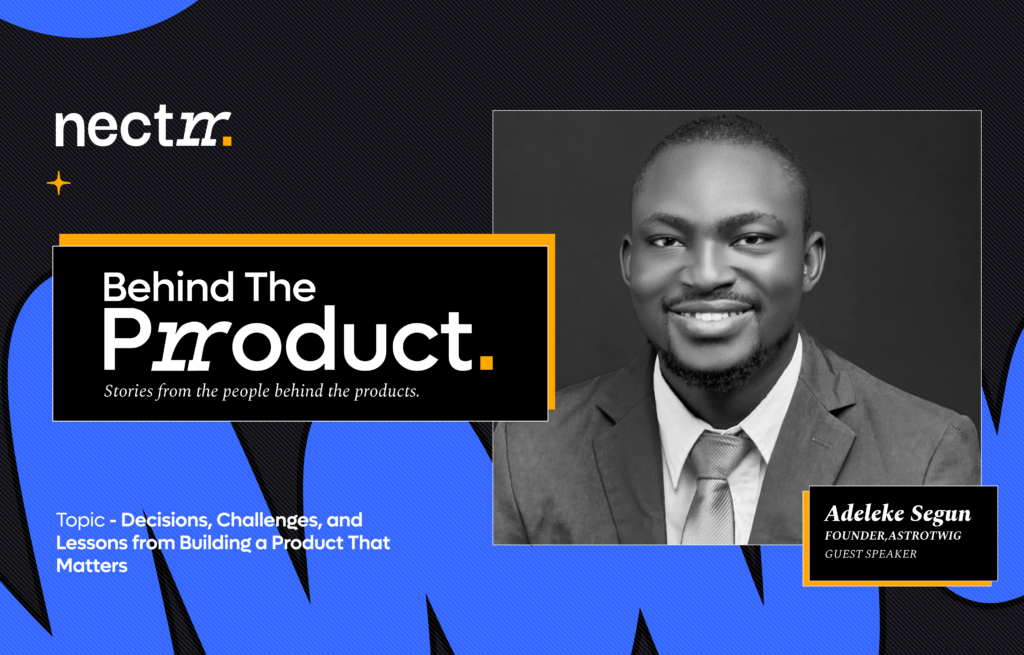
That was the central theme of the first episode of Behind the Product by Nectrr, where we sat down with Oluwasegun Adeleke, Founder and CEO of AstroTwig, to unpack the realities of building a product, from identifying a problem and validating ideas to pivoting, overcoming setbacks and learning how to build without relying on investors.
Rather than a conversation about features and technology, it was a conversation about the decisions, mistakes and lessons that shape products long before they reach the market.
Every Great Product Begins with a Real Problem
For Segun, the inspiration behind Astrotwig came from a personal frustration.
As someone who genuinely enjoys discovering new music, he repeatedly came across incredibly talented independent artists whose work deserved far greater recognition. Despite producing high quality music, many struggled to reach audiences or generate meaningful income.
That observation eventually became a question:
Why are so many talented artists going unnoticed?
Instead of accepting it as just another industry challenge, he decided to find out whether it was a problem worth solving.
Here are a few nuggets that were dropped during this episode by Segun;1. Validate Before You Build
One of the biggest mistakes founders make is assuming an idea has value simply because they believe in it.
Segun stressed that product development should always begin with validation.
Rather than immediately building a platform, the Astrotwig team created a simple survey using Google Forms and shared it across social media.
The response was encouraging.
More than 1,000 people completed the survey, confirming that the challenge was not unique to Segun's experience. Even more telling, independent artists began reaching out directly, asking the team to help promote their music and feature their work.
That early engagement proved something important.
The problem was real.
People were actively looking for a solution.
2. Your First Product Probably Will Not Be Your Final One
Astrotwig did not start as the platform it is today.
Initially, the team set out to build a music streaming platform for independent artists.
On paper, the idea made sense. If artists struggled with visibility, surely another streaming platform would help.
However, speaking to artists and observing their behaviour revealed something different.
Exposure was not their biggest concern.
Making money was.
Artists were not necessarily looking for millions of listeners. They wanted dedicated supporters who would actually pay for their work.
That insight changed the direction of the business.
Instead of remaining attached to the original concept, the team pivoted.
Today, Astrotwig focuses on helping creators monetise directly by enabling artists to sell music, videos and other digital content to their fans.
It is a reminder that successful founders do not become emotionally attached to products.
They remain committed to solving the problem.
3. Flexibility Is One of a Founder's Greatest Strengths
Throughout the conversation, Segun repeatedly returned to one important lesson.
Do not become too attached to your first idea.
Many of today's most successful companies look nothing like they did when they first launched.
Products evolve because customers reveal opportunities founders could not see at the beginning.
Listening to users, gathering feedback and making informed changes is often far more valuable than stubbornly defending an original vision.
4. Understand the Size of the Opportunity
Another important lesson centered on understanding the market before chasing investment.
Segun introduced three concepts every founder should understand.
TAM is the total opportunity available if everyone who could use your product became a customer.
SAM is the segment of that market your business can realistically serve.
SOM is the portion of the market you can realistically capture during your early stages.
Rather than trying to dominate an entire country or industry from day one, founders should begin with a focused audience, solve their problems exceptionally well and expand gradually over time.
Growth is rarely instant.
It compounds.
5. Do Not Build for Investors
Perhaps the strongest message from the session challenged one of the most common beliefs in the start up world.
You do not need investment to start building.
Reflecting on Astrotwig's journey, Segun described his early dependence on external funding as one of the company's biggest mistakes.
The original vision required expensive licences and significant infrastructure, making fundraising seem like the only path forward.
That decision eventually proved costly and even exposed the company to a scam that set the business back considerably.
Looking back, his approach would be very different.
Instead of building around investors, he would build around customers.
Revenue from users creates independence.
Waiting for investors often creates dependency.
6. You Can Build More Than You Think
For founders worried about limited capital, Segun believes there has never been a better time to start.
Modern development tools, AI assisted coding, free cloud services and affordable infrastructure mean founders can launch an MVP without spending millions.
Just as importantly, founders should make use of their network.
Many successful companies begin because friends, designers, developers and collaborators choose to build together before funding ever arrives.
Sometimes your greatest resource is not money.
It is the people around you.
7. Never Underestimate Your First Paying Customer
While many founders dream about thousands of users, Segun encouraged builders to focus on something much smaller.
Your first paying customer.
That first payment validates more than the product itself.
It proves that someone believes your solution is valuable enough to spend money on.
From there, growth becomes a matter of consistently delivering value and earning referrals from satisfied customers.
Products do not grow because founders hope they will.
They grow because customers return and tell other people.
8. Building Is a Long Term Commitment
One of the final lessons from the conversation was perhaps the simplest.
Building products that matter takes time.
Many successful companies spend years refining their ideas before achieving meaningful growth.
Rather than expecting overnight success, founders should ask themselves a different question.
Can I see myself working on this for the next five years?
If the answer is yes, keep building.
Consistency often matters more than speed.
9. Looking Ahead
When asked what he hopes people will say about Astrotwig ten years from now, Segun did not mention funding rounds, valuations or market share.
His answer was refreshingly simple.
"I hope people say AstroTwig helped them make their first million."
That single sentence captures the philosophy behind both Astrotwig and the vision for Behind the Product.
The best products are not remembered simply because they exist.
They are remembered because they create meaningful change in people's lives.
Key Takeaways
- Start with a genuine problem, not just an exciting idea.
- Validate your assumptions before building.
- Stay flexible and be willing to pivot.
- Focus on solving customer problems rather than protecting your original vision.
- Build around users, not investors.
- Make the most of modern tools and your network to get started.
- Celebrate your first paying customer because they are your strongest validation.
- Think in years, not weeks.